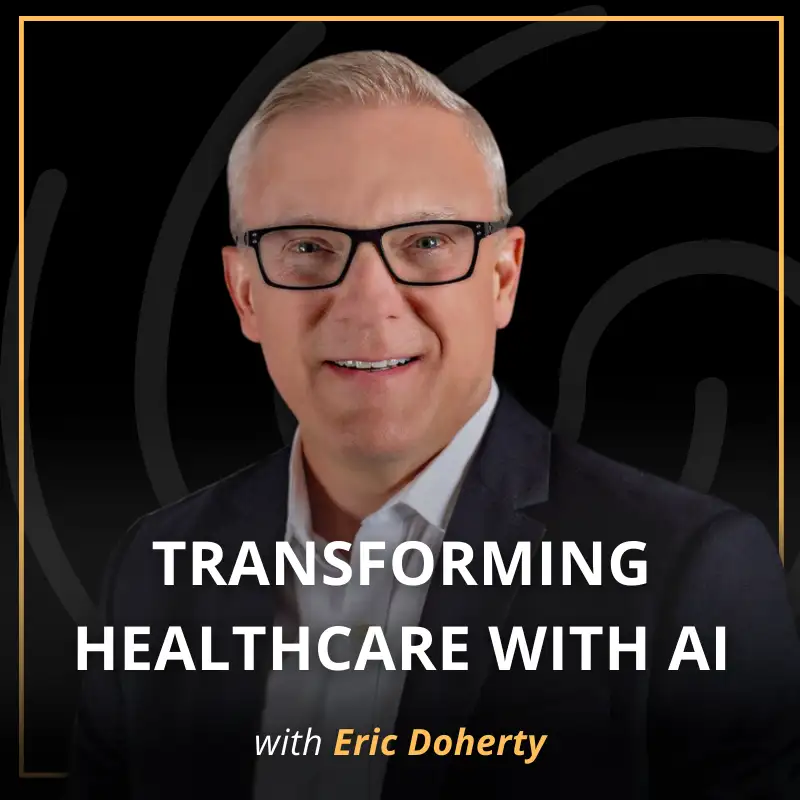
Leadership in the Age of AI | Eric Doherty
Download MP3I am recording this because I noticed in the video that my jacket and everything looks
like a Christmas green when it's really like a teal color.
So I want to record, see if I can record this light thing to see if you can use that to
fix the coloring.
I don't know if you can or not, but yeah.
It's a really beautiful color in person, but it looks like Christmas green there, which I
don't love.
So there we go.
So as like another part of that, maybe I'll just record the intro one more time for you,
Katie, my dear.
So let's do that.
Let's see.
Ugh, look at me, trying to get comfortable behind the scenes.
I was up too late last night.
That's why I look tired supporting a friend, but hey, that happens.
So let's do this.
Welcome to the, I should put the microphone nearby.
This is funny.
It's like it's my first radio.
It's like I haven't done this before.
Okay, let's do this.
Welcome to the Badass Laterist Podcast.
Today, we are speaking to the incredible Eric Daugherty.
Eric brings extensive experience as a healthcare executive committed to transforming
global health through strategic innovation.
With a strong foundation in artificial intelligence, data analytics, and healthcare
commercialization, his career focuses on enhancing patient access, improving care quality,
and driving technological advancements in healthcare delivery.
Over the course of his career, Eric has led initiatives across companies ranging from 250
million to 100 billion in valuation, including notable roles at Glasgow Smith Klein,
Abbott Laboratories, Uvanta Pharmacy Systems, AstraZeneca, and many more.
His leadership philosophy centers on a patient first approach.
leveraging technology and innovation to create scalable, sustainable and impactful
healthcare solutions worldwide.
So join me, Angela Gill Nelms on today's episode of the Badass Leaders podcast, where I'm
joined each week by industry experts for intimate and eye-opening discussions about the
challenges and joys facing the leaders of today.
Listen in and get ready to scale your company, grow your brand and
Unlock your full badass potential.
Rolling.
Oh, awesome.
Katie will love some of those laughs and stuff in the beginning then.
Oh, I just thought.
Oh, darn.
We said all these brilliant things, Eric.
No, just just throw in a sidelong.
joke again if you want.
He's recorded a few of these.
knows my style.
He's known me long enough.
Okay, well, let's officially do this.
We are here, we are here.
This is pretty awesome.
Studio, thank you for inviting me.
appreciate Indie Your Home and this.
is pretty awesome.
Thank you.
Thank you.
And welcome to the Badass Leaders podcast.
I'm super excited.
Me too.
And I want you to kick us off by you tell the listeners and everyone watching, why are you
here today?
Why did you say yes?
I said yes because of the money that was in the envelope that you sent to me.
That was that.
besides that, it wasn't enough.
it was, you know, it got me to think about it.
You know, I honestly thought that it was a good kind of rapport we had on our previous
one.
And obviously the conversation points that we're going to talk about and technology, AI
and kind of the involvement of kind of every angle you can think of around those two is
really where I thought, you we'd have a very good, deep, intellectual
conversation.
it love it so that so that envelope with that fictitious money is still lost in the mail
right
No, no, no, I got the money.
just was those fives and 10s, it just wasn't enough.
I'll remember I remember next time I'll throw in some ones and as well next time sound
good.
yeah exactly I love it so we're here today we're gonna talk about AI right which I know
you're passionate about love it I love it.
are afraid of it.
I don't think they should be.
They should be kind of wary of it but not afraid of it.
we're maybe, we're gonna walk through some of those journeys today as we talk.
And so since you referenced it, you were previously, I guess, on my other podcast, which
is Recovery Advocate Network Coffee of Conversation.
And we talked about AI there, so we'll definitely add the links to that episode in this
episode so people can watch both of them.
But this is gonna be very different, let's dig in.
First off, since this is a leadership podcast, I wanna start off talking about leadership.
We've talked about the difference between a leader and a manager.
And I love to hear what great leaders think about how you define those and then maybe how
as you're growing someone or working with someone, how you then teach them to grow those.
Yeah, know, honestly, the difference is pretty, I think, astounding.
You know, you've got a manager who, that's what they call it, manages, you know, who
basically looks at employees or individuals and manages what they do on a day-to-day
basis.
They don't have any type of...
I think future focus, they don't have any type of future, I think, help for that
individual in mind.
And so there is a huge difference between that and what a leader is.
A leader is somebody who has a vision, who has a direction of where they want to go or
where they want to take a business or take individuals.
So if they are leading a team, and that's the other difference, a manager will not lead a
team.
They'll manage by an individual kind of setting, whereas a leader will more manage in a
team type of environment.
they will have their direction, their thought process, their kind go-to strategy on what
they want to do, how they want to go about doing it, and how they want to achieve it, and
then do it.
And I think that's where the big difference is between the two.
One of the questions when you sent it to me, I was like, ah, I've got some pretty good
ideas around that.
One of them was really that I learned most from my worst person managing me.
absolutely.
that right there is think the biggest tell in that, you I think when you are managed by
somebody or quote unquote try to be led by somebody that doesn't really have that ability
or doesn't have really the insight of themselves and what they're doing, you learn the
most from them.
And I think from that end of things, that's.
I think where I really want to make a valid point on the differences because when you are
led by somebody that is not a forthright leader, you learn the aspects of what not to do
when you become a leader.
Okay, tell me an example.
Surely you have one that we're going to leave the names out to protect the guilty.
Give me an example.
Just the micromanaging part.
Yes.
You I think that's where there's some big issues that can come up, you know, when you're
trying to
lead or manage people, where if you are micromanaging, that's not a leader.
Micromanaging is somebody who's on top of you on a regular basis, on top of you, wanting
this or that.
And it's got nothing to with the business, got nothing to do with how a company can be
run.
It's all about them trying to nitpick on what you're doing as an individual.
And I think for a person to do that,
It's not really going to help the business.
For a person to do that from an employee standpoint, really kind of tampers their efforts
and their expectations down quite a bit.
It doesn't give them any type of, I guess, potential authority.
It doesn't give them any type of insider direction.
And I think in general, just really, I think, diminishes the culture of an organization.
Absolutely, absolutely.
And talk about how can you not inspire someone.
You cannot inspire them by micromanaging them.
That will be the first way to push them away.
Exactly.
And I was going to add too, I think the other aspect of it is when it comes to a leader,
you know, they get everybody involved, you know, from and if you're leading a company,
you're getting your marketing team involved, your sales team involved, your ops team
involved, your finance team involved, your HR team involved.
You're getting them involved in kind of any and every aspect of the business.
You want to make sure that you're transparent with them.
You want to make sure that they are in the know as to what's going on with the business.
You don't obviously can't and you can't give them everything.
but you them what is relevant to what they do.
And I think by doing that, it just really instills a great culture and a great
organization.
Right, you take away this idea of silos, which so many organizations have huge silos and
disparate systems and then people who, and I believe when you set that up, you create a
foundation with a lack of trust.
And that's what micromanaging is.
It's a lack of trust.
That's what you're saying to your team member.
I don't trust you to do your job, therefore, I'm constantly going to make sure I get into
every little thing.
It can also be from past example.
It could also be that they feel that they can do their your job better than that.
They can do your job better than them.
Yeah.
Absolutely.
And then it's to the point of, the whole reason you hired this person is so that you can
go and do great.
And I was just listening to this in a book.
I'm trying to remember which one it was.
And they were talking about, of course, you may be better, in theory, at doing something
than one of your team members, because you used to do it for a long period of time.
And they're going to do it differently, all great things.
So you know what?
Let go.
And do the whole reason you were moved into your new role was to accomplish new things.
Exactly.
Not the old.
And when you're hiring, it's good to hire somebody who has very, good skills, maybe skills
that are like yours as a manager, but you also want to make sure that they are able to do
the job on their own.
Yeah, absolutely independent, independent.
And if they do have issues, that's another story.
That's kind of management or HR thing that comes up and you have to deal with it.
every time you hit the mic after they start.
I'm trying to avoid the elbow.
But yeah, I mean, think that's where you've got to make sure you hire the right people
with the right mindset, but also let them do what they need to do and let them do what
they can do.
again, that just instills a great culture within the organization.
Love it, love it.
So I like to think about we should also in this process get to know humans as humans.
It's my favorite thing.
It's one of the values of the AGM group and the consulting that we do is get to know
humans as humans.
speaking of that, Eric, why don't you tell us a little bit about you as a human and then
we're gonna dig into AI.
That's really sweet.
Yeah, it's awesome.
opposed to a computer.
Great health care background.
I've been in health care pretty much all of my working life.
My dad was a pharmacist.
My mom was a microbiologist.
So I grew up in science and health care, which is pretty cool.
My dad was with Walgreens for a number of years.
So I got that business side of things kind of embedded into what I do today, which has
been very, very helpful.
And just kind of grew into roles within different organizations, both in pharma as well as
medical device.
And then that also has now moved into more in the tech and IT side, as well as the
pharmacy, pharmacy operation side.
So I've had a number of elements of roles that have really touched people.
And I think that's what's been kind of my drive.
I've always been somebody who is in roles or has done things that are very focused on
individuals and helping and making sure that from either a healthy standpoint or a
monetary standpoint that they're helped out and just been in roles that I've been blessed
to be able to do that, which has been pretty awesome.
I've been with large companies and small, I've been with GSK, Abbott Laboratories,
AstraZeneca.
I've with smaller companies and startups.
I like nimble environments of businesses.
I like to be able to have a decision, make that decision, have it go through quickly, as
opposed to a of red tape.
So I like the smaller divisions and or businesses in general.
But I think you can also find companies that are larger that still have that nimbleness as
well where you can get things done.
And I enjoy getting things
done.
Love, love, love it.
Okay, so you have a long career in IT, cybersecurity, and now AI.
let's, can you break down what AI is for individuals who are now thinking, what are they
even talking about?
Can we give some basics?
I'm sure a lot of folks have heard of AI.
I mean, it's been in the the last year, year and a half.
think for most people, it's been around for a number of years.
And it's what's called machine learning AI, where you're taking data or data sets and
you're running basically algorithms and basically you're asking the data to do something
and you're getting back an answer from that kind of question or statement of what you want
to have done.
Where more generative AI is coming into play, which is what is in the news more so now.
than anything, it's where you're taking that data, the systems are being run to give you
an answer, but it's also finding out what is maybe a better answer based on that data or
based on what the outcome was and then based on that outcome and how that reiteration of
data could be going forward.
So in simple terms, generative AI is a way of taking information that's out there and
making it better.
So then taking it to a next level of making a system run better or a platform work better.
or a way of doing things work better in let's say a manufacturing setting, all of that
kind of wraps around the generative AI side of things.
And so both of them are built off of, and the initial part of it, off of data that's out
there.
large language models, boat loads of data.
And it could be a data mark from a wearable watch.
It could be a data mark from any type of EKG, ECG in the healthcare world.
It could be billing information.
It could be financial information, data that's coming in.
You can run whatever you want to off of that to get certain answers that you want to get
to.
Right, right, awesome.
okay, so tell me as companies really start to, companies, organizations, schools, we all,
how everyone in the world is trying to figure out how to utilize AI and often struggling
with it.
We walk through a couple of steps or advice that you would give a company that's like,
hey, I want to start integrating AI into our services.
Do diligence, very, important, making sure that the company that you are looking to work
with is the right company.
You also really want to make sure what your outcome is as an organization.
If you're a school or if you're a financial institution or even a pharmaceutical company,
if you're using some type of an AI platform, what is your outcome that you want to
achieve?
And then can that company do it?
And then again, do the due diligence wrapped around that.
The other aspect of it is just
really making sure that if you do have that outside organization given access to your
data, make sure there's, I guess I would call them kind of gateways that are either open
or closed to make sure that they don't get access to information you don't want them to
have access to.
That's a really key point because nowadays there are so many bad people out there and ways
of getting into bad information and
just making sure that you've got those guardrails and...
He's gonna give an example of what something might be that you might not want this partner
to get a hold of.
Well, there's two ways.
Again, those guardrails are key.
So if you've got the outside company that you're looking at, let's say, contracting with,
making sure they're reputable and all of that, and do your background on where have they
done work prior, how were they perceived, what were their outcomes, and did they work well
with that other company?
The other side of it is internally,
you know, change healthcare.
Uh, it was just released today.
I just saw some of the reports on, the billions that were lost with that change healthcare
cyber attack.
So it's that side of it too.
So if you've got a outside company that's coming in and working with your data, you know,
are there guardrails to not only protect the data, but also protect that company, but also
protect the environment.
And if it's not, there could be potentially millions or billions that are lost in that
event as well.
mean, it's like 2.9 to 3.5 billion.
that was lost in the change healthcare cyber attack.
those who don't know about that, can you describe what happened or what the...
Yeah, yeah, because I got notification in the mail.
My information was one of them.
In essence, there was a cyber attack a little over a year ago, where it was an outside
country that got access to the data and basically took the data out of it was Change
Healthcare, which is part of UHC Optum United Health Group, got access to their data and
made it public.
And not a good thing.
And basically, held it for it for ransom for a little while, got their money and still
released it.
And so the money, though, that was lost
in that situation was very, very overwhelming.
And again, into the billions.
And it can happen to anybody.
It can happen to a Ma and Pa, you know, a little store down the road here in Atlanta, or
it can happen to, again, big organization up in Minneapolis.
Okay, so now that everyone's terrified of AI, we would just say that they're afraid of it.
You know, one of the things I was just thinking about is I wonder if at some point
insurance companies are going to start offering some sort of AI insurance.
I mean, you have directors and officers insurance, you have cybersecurity insurance that
people are required.
I wonder if at some point, or if they're just going to tie it into the cyber.
They would tie that into the cyber security risk.
it would be part of that.
insurance company this idea and they use it, they make lots of money.
I want a portion of the money.
I'm just saying it right now.
You heard it on the Badass Leaders podcast.
Angela Gill Nelms, can mail me the check.
I'll send the information.
Maybe I'll get that cash.
Yeah, exactly.
Maybe they'll attach it to the cash.
That'd be perfect.
And I think too, the aspect of AI, and again, using that environment, I'll go back to the
change healthcare.
Did they have the right guard rails in place?
Did they have the right gating system in place in the security system and all their IT
platforms?
No.
No, they did not.
And obviously they did not because that wouldn't have happened had they had it place.
So, you know, there's just got to be a way within an organization, both at the top
leadership to really make sure make sure that they are looking at it, as well as the IT
group within the organization.
But just making sure that you're doing your due diligence and making sure that your
systems are.
Avoiding any type of issues any any type of obviously threats both inside and outside
because it can come from inside as well And just making sure that those are taken care of
on a very very regular basis and looked at on a regular basis
You know, one thing I was thinking as well is that new companies, a beauty a new company
has is you can build your data infrastructure from the start thinking about how you want
to put those guardrails in to protect that information.
Like the rest of the company, I mean, all these companies are out there and when their
data system or their data lake was built,
They weren't thinking AI was going to come in and dig and make assumptions and then
potentially, you know.
Maybe the AIs come in and now they have access to your HR folder.
And then next thing you know, you say to this one team, we want you to use this AI thing.
And then everyone on the team knows everyone's salary and now it's fully disclosed or
knows everyone's performance review or something like that that should not be right.
And yet if we're thoughtful about it for those entrepreneurs out there, they're starting
their businesses.
It's a great time to do research on these things.
Yes.
As a startup company, very, important to do it that way.
Yes.
And it makes things much easier down the road.
Yeah.
But as we all know, there's a lot of companies that can't do that because they already are
working with data.
And so again, just making sure that their systems have those guardrails in place and those
access points denied or closed off.
And I think it's also training.
I think a lot of it has to do with the training of the folks on the team, both small teams
and large teams, or maybe the entire corporate team.
ensuring that that training is there as well because there are, you know, everybody gets
emails, right?
And so there's links and emails where you get these texts nowadays and they're fabricated
texts.
My mom literally texted me a couple of days ago about a text she got from the, I think it
was either Mississippi or Florida toll system.
And it was not a correct text, but if she clicked on that link, who knows where it would
go and what it do.
So those things are coming up all the time.
So that training part or educating part is really saying, hey, don't open everything you
see on
email or text.
Don't click on anything you see that looks iffy.
Do your due diligence on that before you do the clicking to ensure that those things don't
happen.
And I will say from experience, we had an issue with this at a couple of companies ago
that I worked at in that Outlook, you the little bar is supposed to say if this is from an
external or something like that, they had some sort of bug and some of the emails were
coming through that were spanned or that were phishing emails and they did not have that
on there.
And sometimes people get used to seeing that as a red flag.
And if you don't see that and your CEO is asking
you to go to Starbucks and buy all these gift cards suddenly.
would be very odd.
True story.
I did have a previous employee who did that and bought them Visa cards.
And then thankfully, before he sent them anywhere or did whatever he was supposed to do
next, it occurred to him, this doesn't seem right.
And he reached out.
I don't know.
I don't think so.
I hope not.
But yeah, but it was also like when he did that I I was caught off guard because I thought
why would you do that?
Like you're a smart human being and it's a reminder that smart people get tricked by these
things all the time.
Yes, right.
It's not just the L.
mean I do have a friend who their elderly parents lost $30,000 recently to a scam via one
of the click thing.
and they're hitting the elderly population big time.
Yes.
Any way they can.
And again, is there AI involved?
Yes.
mean, AI is pulling probably information somehow some way about demographic age group
here, location here, pulling it up, figuring out who's using their phone, who's not using
their phone.
All of that's probably from a bad person standpoint used by AI.
Yeah.
Using AI.
Yeah, and we're not giving anyone new ideas because they're already happening!
And I was like, stop, Eric!
Don't say anything more!
I know, I know, know.
Next time.
So I think then with this, a company is start, so let's talk about the companies that are
starting to use AI and talk about what rules and regulations currently exist and how you
also potentially see that those may change over time to improve the process.
So for small companies, nothing is out there rule and regulation wise.
Nothing's been set.
Nothing's been put out as a law.
It's more for the larger organizations just to make sure they're protecting the data.
And we're talking anything over, I believe it's either 10 or $100 million in revenue.
it's really the larger companies that have to abide by this.
And there are some guiding principles.
The White House came out about a year and a half ago with their kind of guideline around
that and making sure that if the data wasn't protected, the organizations would be fine.
So there are some I would say minor type of rules right now.
The EU also came out with theirs.
Will they be updated probably as we go along because obviously it's becoming more and more
of a
day-to-day kind of concern.
But for right now, small companies don't have to really abide by anything, which is also
kind of scary if you think about it.
But I think when you're starting out an organization, like you mentioned earlier, just
making sure that you're putting systems in place that are starting to look at that and to
make sure you're protecting the data and make sure you're securing the data, make sure
there's not many people that have access to the data.
All of that kind of goes into starting up and setting up a system to ensure that
there's...
non actionable bad people getting into the data.
Right, and I think I'm a big believer in checklists and things like this.
And one of the things I observed in a previous company that I came into as COO was when
they off-boarded employees, they weren't removing their access from a whole bunch of
stuff.
Wow.
And so no one was going in and doing access reviews.
I typically, I personally am a believer in doing quarterly access reviews of your
important systems and making it a requirement.
you could do more frequently.
on a cadence that is a set cadence that you always do and you document it with proof that
you did it.
And that way because here you have these former employees who still had access to
documents that were new document.
Right.
had access.
Yeah.
Yeah.
So
That's very important.
And you know, I think again, me and the healthcare side of things, that's one of the areas
that they've always been, I would say, pretty pretty concerned with.
They've always had a kind of focus on ensuring that the systems are locked down and all
that.
You know, typically every week for the IT team is probably a norm, if not more often.
I hit it again, by the way.
I laugh every time internally.
the other would be, again, just making sure the equipment's turned in and all of that.
And again, have those checklists for employee checkout because it does, I think, yeah, you
can definitely open yourself up for a lot of issues, especially if the employee left on a
negative issue or a negative account.
if we adjust that and shift it.
I like knocking it because it doesn't bother him.
doesn't make any noise.
Now look we have the stranger on our set Yes, yes what now Or ruffle right that's a
different story
for those of you that are just listening.
Thank you.
Thank you.
For those of you who are just listening, our offset producer just came in and adjusted a
microphone that Eric was determined to.
We're totally not editing that out.
And again, for you all that are listening or watching, there's a backstory, so she'll tell
you about that.
Yes, exactly.
I'm trying so I'm trying now.
Now I'm off my game.
Let's look at the note cards Angela.
Okay, what are some rules maybe that some common rules that can be accidentally broken
when using AI?
So we just talked about access, but what are some other ones that people should be
cognizant of?
Just making sure that the data that you're putting into a system to have AI run on is good
data.
That really is.
just making sure it's, when you're looking at either clinical trial information or drug
discovery information, or if you're trying to work an AI platform in a manufacturing
facility, the data that you're putting in has to be relevant, has to be up to date, has to
be...
I would say closest to real time as possible just to ensure that you've got the structure
of a data complex to have the AI run out of it.
So that's probably the biggest thing.
I think the other aspect of it is just, again, really ensuring that you've got the...
Outcome in place, and you have the algorithms, again the modality of hey, this is what I
want the data to do and bring me as far as outcome of data, what that looks like and how
succinct you've made it.
Because if you make it too broad, it's going to give you a broad answer.
If you make it too tight, it's not going to give you as much information as you need.
You need to make sure it's bold enough and strategically set up enough to where you get a
straight line outcome out of your data to ensure a good decision making type of mode.
Okay, yeah, and it's kind of pausing to say what a success look like at the end.
Yep.
Defining success and what those variables are and then making sure the questions of the
data or the information you put in has the ability to reach that goal.
Correct.
It's gonna be structured that way.
good example, let's say a manufacturing facility.
How do you speed manufacturing?
How do you increase the efficiency of manufacturing a widget or whatever?
The data you're going to be putting in would be everything from the man hours.
the time it takes to put this piece on that piece and to mold this or mold that, et
cetera.
All of that's data.
And so as that's being put in, just making sure that it's all, again, relevant up to date
and correct information.
And then once it is, let it run.
Let's talk a little bit about the power of AI.
so we're talking about rules, regulations, things that you should be stressed about
because they can have a downfall to your business, put you out of business, Destroy your
brand, destroy your reputation, all those types of things.
so one might think, wait, why are you even doing AI has all these risks, but AI is
powerful.
So why don't you share some about the power of AI.
Yeah, again, I think where we are at today, again, using machine learning AI for 20, 25,
30 years, it works.
That always has been something that is a go-to type of AI strategy we've used in the past.
And it's given good information.
But it's not given us any feedback or.
information that makes that decision or that makes that information better.
And so with the generative AI, that's what it's doing.
And so the power is that basically as you are getting that data in, let's say, a machine
learning mode and transferring it over into a generative AI mode, the aspect of taking old
data that you've run it off of, excuse me, run it off of, hit it again, for those people
who are not watching.
And basically allowing that data to be enhanced to find better ways and better modalities
of doing things.
And that's really the bottom line.
think it's the power is allowed because you're taking data and making ways of doing things
better.
And that is powerful.
mean, even from a mobility standpoint, from a...
We talked about manufacturing efficiencies there.
I look at the healthcare side.
mean, everything on AI now really is being pushed towards, you how many hours are the
nurses on the floor?
How many hours are the doctors on the floor?
How many hours are they spending with patients?
All of that's coming into play where, you know, maybe they're not spending enough or
they're spending too much.
And that AI part that's being pushed into their systems and looked at is just making
really cool outcomes and saying, hey, this is a better way of doing it with this patient
or that's a better way to do it with that patient.
Yeah, I love that because I think that.
I know at Georgia Tech, I'm on the College of Engineering Board and I'm on the board to
the president.
And one of these two meetings years ago, I believe it was College of Engineering.
This was back when, so I believe it was like maybe, it may be exactly two years ago.
And the schools started to say, wait, should we allow, should we take away the entry or
the application essay?
Because people are just gonna write it.
with AI, should we do that, right?
And what Georgia Tech decided was that, we're not going to, because the reality is if you
think about it...
people have had AI for a very long time.
You know what they had?
They had a two, their family could afford to pay someone to help coach them through or
review or, and so Georgia Tech decided all we're doing is leveling the playing field.
And what we want to be able to see people do is what are you gonna do with that
information that you get?
Because you can very much tell if someone's written something with AI and not touched it
afterwards.
been a lot of things I've seen with people writing AI.
They've sent it to me and you can tell where it's either misspelled sometimes, very
rarely, but it is, or just the the grammar that's put into it is just not correct at all.
And yeah, it's it's it's interesting.
know, one of the things I wanted to mention, too, you know, for those, again, that might
have a fear or a wariness of AI, you know, think of AI as being kind of our Google 20
years ago, 25 years ago.
You know, I think that's where a lot of folks, I think, will
go, you're right.
Because remember if when we had Google first come out, we would Google a search term or a
phrase or whatever, and it booms, shoot us information.
That's basically what this is doing too.
If you're on chat, GPT, or OpenAI, you put in whatever you want to look for, it's pulling
information from all over the place, which is what Google did.
But it's making it more succinct and more, I would think,
down to a level of exactly what you want to have as an outcome.
So if you want a job description, if you want a picture of whatever, it's giving you that
because it's all the data it's pulling in.
And so if you weren't really afraid of Google, AI is probably not something you should be
afraid of.
But again, with Google, you want to be careful of what you're asking it and what you're
trying to look for because the data that comes back may not be appropriate or may not be
factual.
Same thing with chat and open AI.
The stuff that's coming back is probably
potentially not going to be factual.
Well, and I love the fact check part of it and thinking about using it and forcing
yourself to do the fact checking as well.
Also being cognizant of confirmation bias and have you put in confirmation bias is when
you get it, you put something into it with an assumption and so then it gives you that as
the answer.
And so if I find if you're aware of and thinking about confirmation bias, then the inputs
or the questions you're asking,
you can structure those in a way to reduce the amount that you're just gonna get.
If you type into Google, I don't know, some disease thing and say it has this, that, and
the other, do I have it?
Like going to WebMD, right?
Then it's gonna give you all the ways that align to how you have it.
exactly that is exactly an open AI and chat GPT would do the same thing ironically.
So yeah, yeah very similar.
That's what I'm saying.
It's it's there's some like good good elements bad elements.
She's got to you know treat it like you did with Google.
Same type of thing.
I love that.
And I think like some good things.
I love AI as you do too.
So here we're both talking about these like scary things.
Don't be scared.
Because I also think that AI can empower every individual to spend more time doing the
things that are unique for them and their skill set and not waste a lot of time.
For example, a job description.
OK, you could say I'm not using any AI.
I'm going to sit down and write my first
job description by hand.
Okay.
And now you're going to spend six hours writing a job description.
Right.
We're in the past we went to Google and got a job description.
Now?
we would copy it, probably edit it and that type of thing.
Yeah.
know, format.
But yeah, now you're able to use AI to get things like that.
Yeah.
Yeah, yeah.
And to automate, I also think of like automating processes like even for the podcast,
right?
The minute that Katie puts in, Eric said, yes, right.
AI and Asana is going in and going, OK, these are all the next steps.
Go do that.
Yeah.
So I think in that way, you can utilize some of those things to help you even build in the
processes that you need to in your organization to have all those checks and balances to
be safe from those fun people who want to send you the links to the toll that you owe.
Take down your whole system.
the flip side, so what's happening to the the business has been enhanced because of the
ability to do things like that in chat and open chat GPT and open AI in that there's
systems now in place that can take structured data that you've put
again, six times, seven, structured data that you put into a document or wherever you put
it on your system, they can actually search and figure out if it was AI driven.
So if it was AI made.
So there's actually systems in place, you mentioned the Georgia Tech earlier, there are
systems in place that can actually do a check on that to see if it was written by AI.
That's what's pretty crazy.
Yeah, and but I think that everyone needs to hear that and remember that.
And if you think that you're right or you're doing something and no one's going to figure
out at some point.
It's going to be figured out.
They will and then it will go against your integrity and stuff like that.
And I use AI to help in writing the blog posts that I write because it gives me the
initial talking points that I can then expand upon and stuff like that.
So I think that's where the power can be and can, like the power can really thrive in a
healthy way.
But if I haven't write a blog post and then I don't do anything to it afterwards.
There is a problem with that.
Right.
Don't you?
doesn't.
It's not yours.
Exactly.
And I think also, too, the the cool thing about it is that you can, you again, when you're
defining what you want, so going back to manufacturing, the example I gave before or doing
something on your own, were you trying to write a, you know, some type of blog post or job
description or whatever, you know, if you have it defined on what you want as the outcome,
as long as you're editing it and doing it in your style, that's cool.
What's kind of scary again for those high scared people out
What's scary is that as you're always kind of using chat GPT or open AI.
It's also seeing how you do that
Yeah.
it senses and gets an idea as to how you, I would not say think, but potentially, but how
you are responding or typing or asking.
And from that then it's also getting insights as to how it can give you information back.
A good example is that as, know, and if you mentioned Outlook earlier, basically as you're
typing sometimes it'll start pushing out words that might be what you're trying to type
and then swipe here, whatever it
is now on Apple.
It's getting a sense of how you write and how you verbalize through typing or through
messaging.
And again, that's all AI.
And you think about it, there are some great things about that, right?
Then efficiency and.
right?
And then there are also some not so great things.
I wouldn't when people read something from me, they often say I can tell that it has your
voice in it.
Right.
And and so I think if something were to get that good at mimicking Angela's voice, then
maybe something has been written that I didn't write.
That's not something that I would ever write because it is, I don't know, scary criminal
You know, I don't know.
You know, the next check will be going to when I'm in prison for something that I didn't
even do.
But because it has learned how to talk in Angela's voice, then someone can manipulate and
take advantage of that.
Yeah, yeah.
I actually got a little scared just then.
I thinking, I don't look good in orange.
Like I really do not look good in orange.
don't.
don't.
OK.
So when you think about companies out there that have implemented
the utilization of AI.
We talked about change healthcare and what happened with that.
Can you give us some examples of perhaps a company that you think has done it really well?
Ooh, tell me more.
So they actually have an AI chief chief chief AI director or chief of AI that oversees all
of their different AI platforms and what they're doing.
you speaking of Mayo Clinic?
Yeah.
Not Mayo that you put on the ham.
not mayonnaise and not the quarterback from the Tennessee Titans.
Cool.
But no, we're we're you know, on the Mayo Clinic side, you know, they've three sites now
in Minneapolis, down in Jacksonville and then out in Phoenix.
And, you know, they're really pushing the element of AI in health care and trying to find,
again, better ways of treating patients, better ways to increase their outcomes, better
efficiencies within their organization.
And they are very well run organization.
My mom actually was up there
about four months ago and was, and again, she's a microbiologist.
So she's been in that kind of science health space and so she knows when good is good and
she was like, this is great.
And pretty cool how they had their system set up.
But on the AI front, they are really looking at from sensor data to EHR data to, again,
nurses on the floor, how does that all interact and how does that make a patient outcome
better?
They're really striving towards that, and the use of AI is just apparent throughout their
whole system.
Yeah, yeah.
So one thing that you said to get back to leadership that really stuck out to me is they
made a decision that they were going to take it seriously and they made it someone's job
description to actually do that.
Yeah.
And more and more are doing that.
If you actually look, I would say of the top 500 companies, I would say probably about 60
to 70 % have started really looking at and or put it in place where they've got somebody
that really not a, you know, not the chief of IT, but it's literally an AI chief.
And I think that's kind of where things are going direction wise, where you've got those
folks who either have the PhDs or have worked in that large language model type of system
with AI and they're bringing them on
to really make sure that hey, if we're gonna put a system in place, I want somebody that
can lead it, that knows it and can run it, but also make sure that it doesn't hurt the
business.
And so they have to have somebody with that expertise to be able to do that.
So we just created a whole bunch of new jobs.
there are.
And a lot of people are also fearful.
tongue tied.
A lot of people are also fearful of the replacement of humans in roles with AI and what
that will have on the economy and these individuals who now might not have the same job.
Now, I have some thoughts on this, but tell me what your thoughts on how really we can
shift out of that mindset.
Well, don't know, shift out of it.
think what is happening is you've got a lot of redundant type of roles or.
easily transferable to technology roles that are being basically replaced from a human
standpoint into a machine standpoint.
There's a lot of the things going on on logistics as an example, where you've got a lot of
these companies like Amazon and others that are using basically robots and things of that
nature to move product and basically move through a system.
And that's all run by AI.
They're using systems in place to make it run, make it run better, and make it run more
efficient.
they're saving a lot of money by doing it.
Where I think the aspect of kind of the employment side of it from a human end of things,
there are opportunities.
Like I said earlier with the chief of AI, there's that side of it, there's the IT side,
there's more the service side is still I think a big area that there still needs to have
human involvement.
The delivery side, I'm gonna throw that out, you got all these folks now using these
delivery companies, will that be?
AI driven and will that be non-human driven?
Probably.
It's kind of crazy what's going on.
But I think those IT roles, the roles more on the service end and that kind of still human
touch needs to be there.
But a lot of roles that are kind of the redundant roles are the ones that are be replaced.
Right, right.
And so this has happened.
It happened in the industrial revolution.
Like this is not the first time that the world has panicked because something may have an
impact on the workforce that will be viewed differently depending on where you fit into
the workforce.
And we have pivoted in the past very successfully.
People have learned new skills.
They've, you know, through different types of education, different types of passions,
those sorts of things have then pivoted and been
quite successful.
So I think there is so much hope for that.
Yeah, I mean I would say there's hope there's trepidation.
Yes, you know because I think a lot of folks don't like the change aspect They don't feel
comfortable with change and and I think that's kind of where There are those that do
change and those that don't I didn't hit it that time there and those that don't and The
ones that don't get passed by and it's unfortunate, but it's happened before as you
mentioned it's know, it's just sign of the times There's the there was the model t there
was the phone there was electricity all those little things
Yes, they're game changers.
AI is a game changer.
Well, I think of an example such as like Kodak and when they made the decision that they
weren't going to really go into digital photography because they made so much money on and
pictures are meant to be printed.
Yeah, this is what we're gonna and the impact it had on their company.
The same thing with Blockbuster.
Yeah, no, and the Blockbuster story is they wanted to keep their stores because they I
think their incomes like 12 % on late fees.
Yeah, exactly.
Yeah, because of all the returns that weren't happening.
exactly.
And we see now that Blockbuster is out of business.
Yeah, exactly.
And so how do you, what advice would you give leaders as they're working with their teams
on how they can get their teams and their team members excited around the potential for
this in a healthy way?
goes back to the training, goes back to the education, making sure that again, the
knowledge base is there, that it's here to be a tool, here to help.
here to make things more efficient.
And as long as they understand that, that's a key element.
But then also making sure that they're involved.
I think it's very, very key that they understand the why and how and what we're doing and
then what the outcome is.
And I think if they understand that, that makes it much, much better for the organization.
And I also feel that they need to be part of kind of what the organization wants to do
with it.
What are the full impacts of what the organization is trying
to drive towards that involves them and how that in their day-to-day working life involves
them.
And so I think if they understand that and have that buy-in, that'll be very, very key.
And the education and training is very, I was going to say elemental, but it's elemental
to what's needed because they need to understand how to use it, where the good and the bad
can happen.
And as long as they get that, that's perfect.
Yeah, yeah, I love that.
And so as we know, a good leader.
Thank you, Bless you, excuse you, et cetera.
For all of the listeners here like what is happening in the studio today?
I mean, you we have a producer offset who's coughing We have Eric who promised us before
we started he was not gonna hit the mic and is now you're eight, right?
Yeah.
Yeah, so for all the listeners who are like, why did he just say eight?
That doesn't even fit into the sentence.
He just said it's the number of times he's hit the mic.
You haven't knocked it over yet though
No, no, no, I thought I my elbow.
I mean we still have progress for the rest of the episode.
You have time.
You can that, right?
So I think one of the things I was thinking of, so as a good leader, what does a good
leader do?
A good leader creates the vision and then figures out the milestones and the different
pieces to have the vision be successful and then communicates that in an environment to
everyone so that you're all running in the same direction and you understand where you're
going and you're actually
a team versus a manager who's just like, we this problem, this problem, this problem.
You know, I don't know.
Exactly, exactly.
And we don't we don't we don't talk to managers on this podcast.
It's requirement.
have to be a badass leader to be a guest on the podcast.
So Scott said he was going to add it to his LinkedIn.
I'm you can add it to your LinkedIn.
think that's a special thing.
I'll have to get some plaques for some people.
Okay, is there anything that you really hoped we would cover today that we haven't
covered?
You know, just, again, for those folks who are concerned or worry about AI, there is, you
should have a wariness.
You should be thinking about it, but you shouldn't be scared of it.
you again, there's some really cool aspects of what AI can do in so many realms of our
world.
You know, one of the things that's pretty cool, you look at population health, look at
underserved areas of not only the United States, but underserved areas of the globe.
There's so many ways that AI will be impacting those individuals, both from food
production to medication and the right medication for the right people from a health
standpoint, potentially lowering costs of medications over a period of time because it can
be developed better.
are cool things that are coming into play on the healthcare side.
And then I think ultimately, I look at cancer as an example, where could AI really help in
potentially solving cancer and solving basically the kind of holy grail of cancer
treatment?
And I think in time, it'll be able to do that based on what's happening on the data front.
And I think that really kind of hopefully gives you some hope and some thoughts on where
AI can be of benefit.
On the flip side, again, you just got to really be careful with how you're using it, where
it's being used, who has access to your data when you are using it, and just making sure
that those guardrails and those ways of defining who gets the data, where it's used, and
how it's used is very, very key.
And if people say, know what, Eric is so smart, I need more information, I need to work
with Eric, how would they do?
I'm on LinkedIn, so you can get ahold of me there.
Would love to have chats with you if you have that need.
Always available, so definitely able to get.
love it.
collaborate, yeah.
And I would say to teams, like get excited.
Like there is so much, like you said, there's so much hope.
yeah, big time.
Big time.
And again, it's new and it is shiny.
Does it have kind of its faults?
Yeah.
Does it have his little scratches?
Yeah.
But it's much, shinier than the scratches.
And there's so much more you can do and much more that can help an organization and
obviously helping us.
mean, you've seen the iPhone downloads and you've seen obviously all the different
Microsoft downloads.
Everything's being run now on AI or at least it's got the background of AI.
And so it's already there and it's
It's just how can you use it better and how can you make yourself more efficient or your
business more efficient or your team more efficient.
And there are really cool ways with AI that you can do that.
Yep.
And we told you some things to watch out for.
So maybe listen to this episode a few times as you're building your strategy and say, yes,
I remembered those items and just go crush it.
Motivational quote time.
is a requirement to share a favorite motivational quote.
is
Yeah, you know I grew up in high school when this was happening But if you all are
familiar with Jim Valvano who was the North Carolina State basketball coach back in it was
83 when he was leading their national basketball team Championship he developed cancer
afterwards shortly thereafter and his motivational quote was never give up never ever give
up
And it's just a quote that's always sunk with me, stayed with me, always with me, and hold
dear and true to me and think of him, which is cool.
But also just think that it's a really good way of looking at how to do things either when
you're on a basketball court or at the gym or in a work environment.
And there are ways of getting things done and finding those ways are part of that never
give up part.
Love, love, love, love.
All righty.
Well, thank you so much for joining us today.
It was amazing.
Awesome.
That was great.
Thank you.
Thank you.
Hope you had fun.
Hahaha!
microphone nudge at the end is my favorite.
You should have just knocked it over.
Thank you.
You got it all Phil.
There you go.
I did tell you.
Creators and Guests